

Today, we’re thrilled to announce that Mercury 2 is available on Azure AI Foundry, the world’s fastest reasoning language model, built to make production AI feel instant. This release combines Inception’s breakthrough diffusion architecture with Azure’s enterprise-ready infrastructure, giving developers access to a model that delivers both exceptional speed and quality.
Built by the team behind foundational AI technologies including Flash Attention, Direct Preference Optimization, and the original diffusion models for images, Mercury represents a fundamental shift in how language models generate text. Developers on Azure AI Foundry now have access to a model that excels in latency-sensitive applications where the user experience is non-negotiable.
A new foundation: Diffusion for real-time reasoning
Mercury 2 doesn’t decode sequentially. It generates responses through parallel refinement, producing multiple tokens simultaneously and converging over a small number of steps. Less typewriter, more editor revising a full draft at once. The result: >5x faster generation with a fundamentally different speed curve.
That speed advantage also changes the reasoning trade-off. Today, higher intelligence means more test-time compute — longer chains, more samples, more retries — bought at the direct expense of latency and cost. Diffusion-based reasoning gets you reasoning-grade quality inside real-time latency budgets.
Performance: Speed & Quality
Mercury 2 shifts the quality-speed curve for production deployments:
Speed: 1,009 tokens/sec on NVIDIA Blackwell GPUs
Price: $0.25/1M input tokens · $0.75/1M output tokens
Quality: competitive with leading speed-optimized models
Features: tunable reasoning · 128K context · native tool use · schema-aligned JSON output
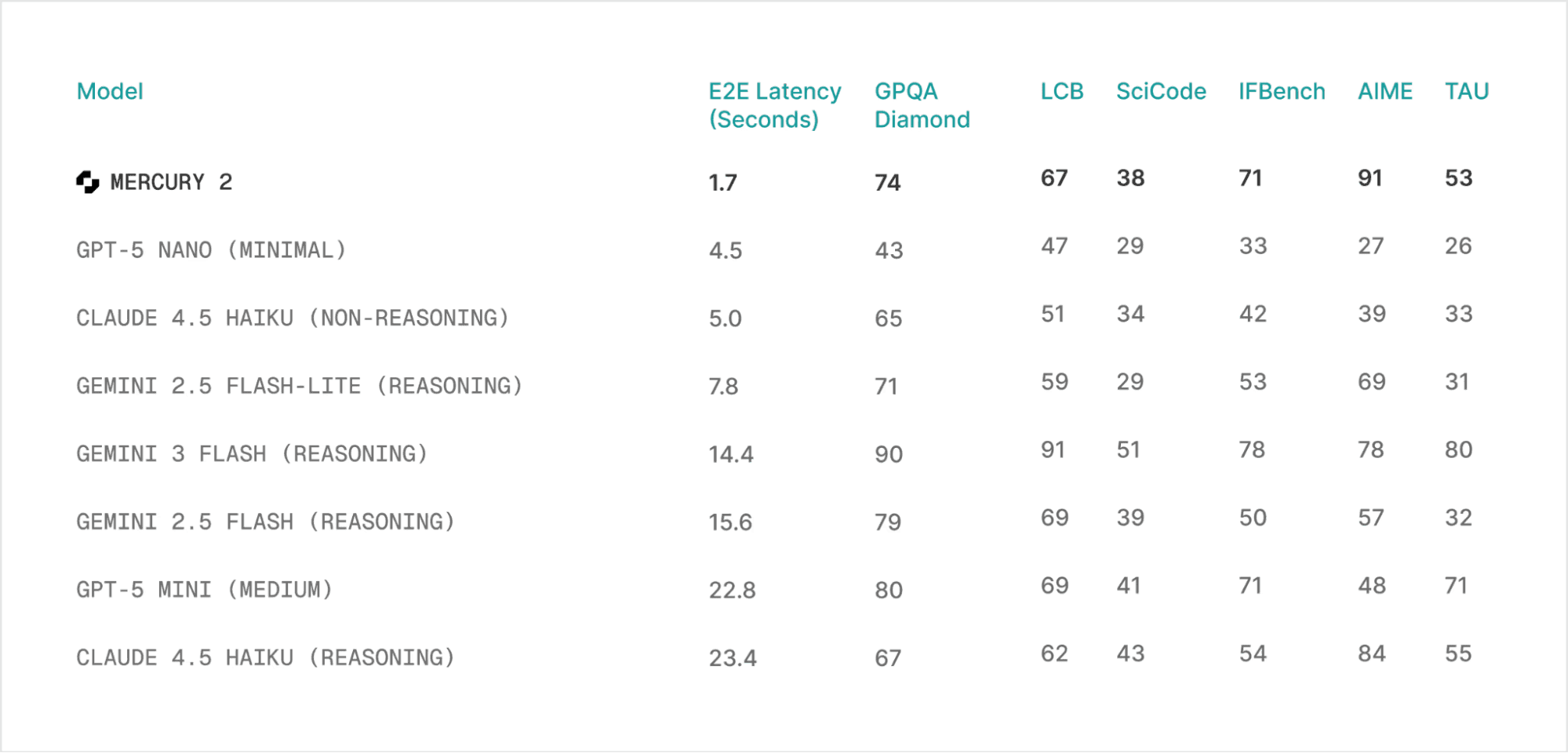
We optimize for speed users actually feel: responsiveness in the moments users experience - p95 latency under high concurrency, consistent turn-to-turn behavior, and stable throughput when systems get busy.
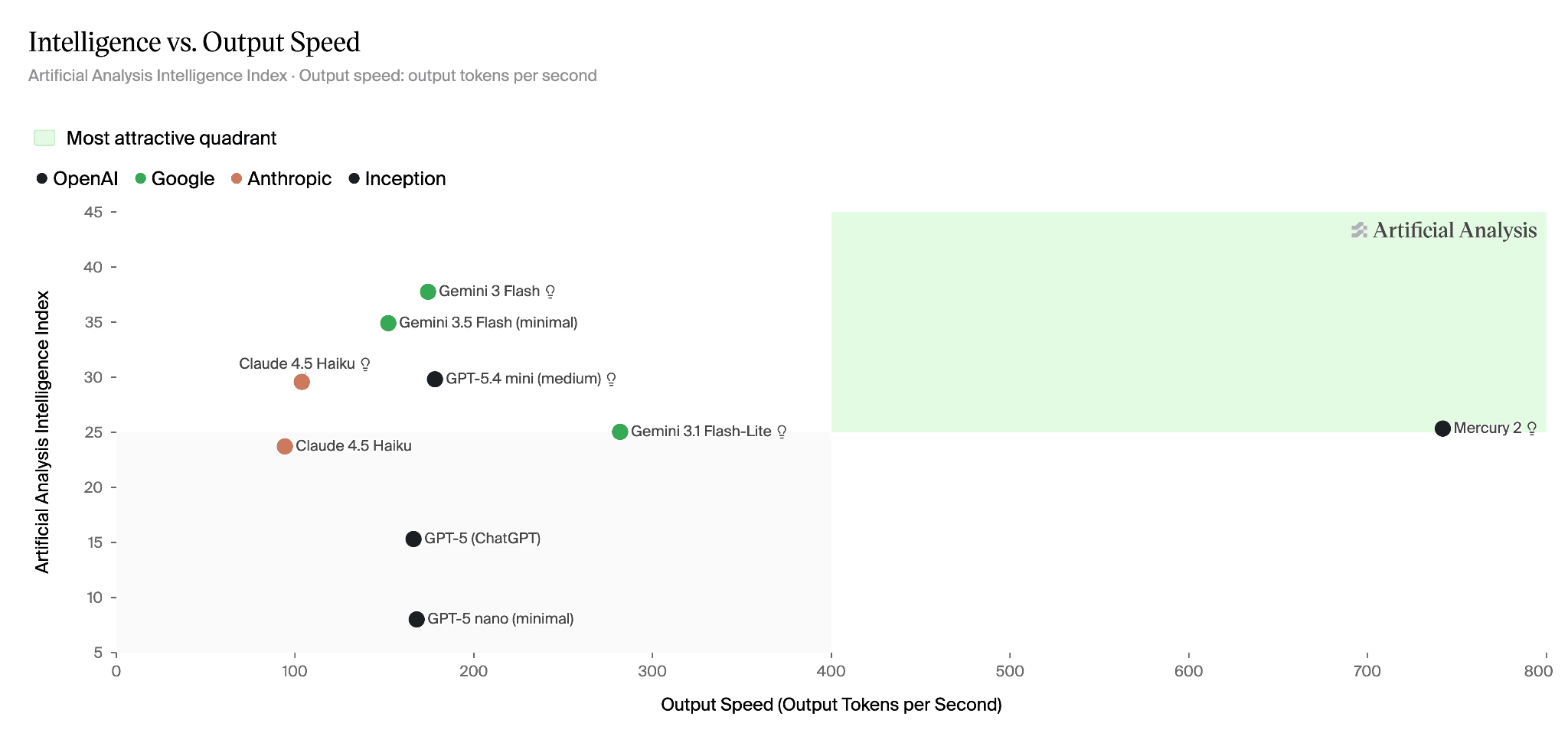
Enterprise-Ready on Azure
Mercury 2 on Azure AI Foundry is production-ready out of the box. It features a 128K token context window for processing large documents and maintaining extensive conversations, with native tool calling and structured output support using JSON schemas for building agentic workflows. The API is OpenAI-compatible, making integration with existing codebases seamless.
Azure AI Foundry provides enterprise-grade infrastructure, including network isolation, data privacy guarantees ensuring your data stays in your Azure environment and is never used for training, Azure compliance standards including SOC2 and HIPAA, and comprehensive observability through Azure Monitor and Application Insights.
Real-World Use Cases
Mercury 2 excels in latency-sensitive applications where the user experience is non-negotiable:
Coding and editing: Autocomplete, next-edit suggestions, refactors, interactive code agents - workflows where the developer is in the loop and any pause breaks flow.
Agentic loops: Agentic workflows chain dozens of inference calls per task. Cutting latency per call doesn’t just save time, it changes how many steps you can afford to run, and how good the final output gets.
Real-time voice and interaction: Voice interfaces have the tightest latency budget in AI. Mercury 2 makes reasoning-level quality viable within natural speech cadences.
Search and RAG pipelines: Multi-hop retrieval, reranking, and summarization latencies stack fast. Mercury 2 lets you add reasoning to the search loop without blowing your latency budget.
Deploy on Azure AI Foundry
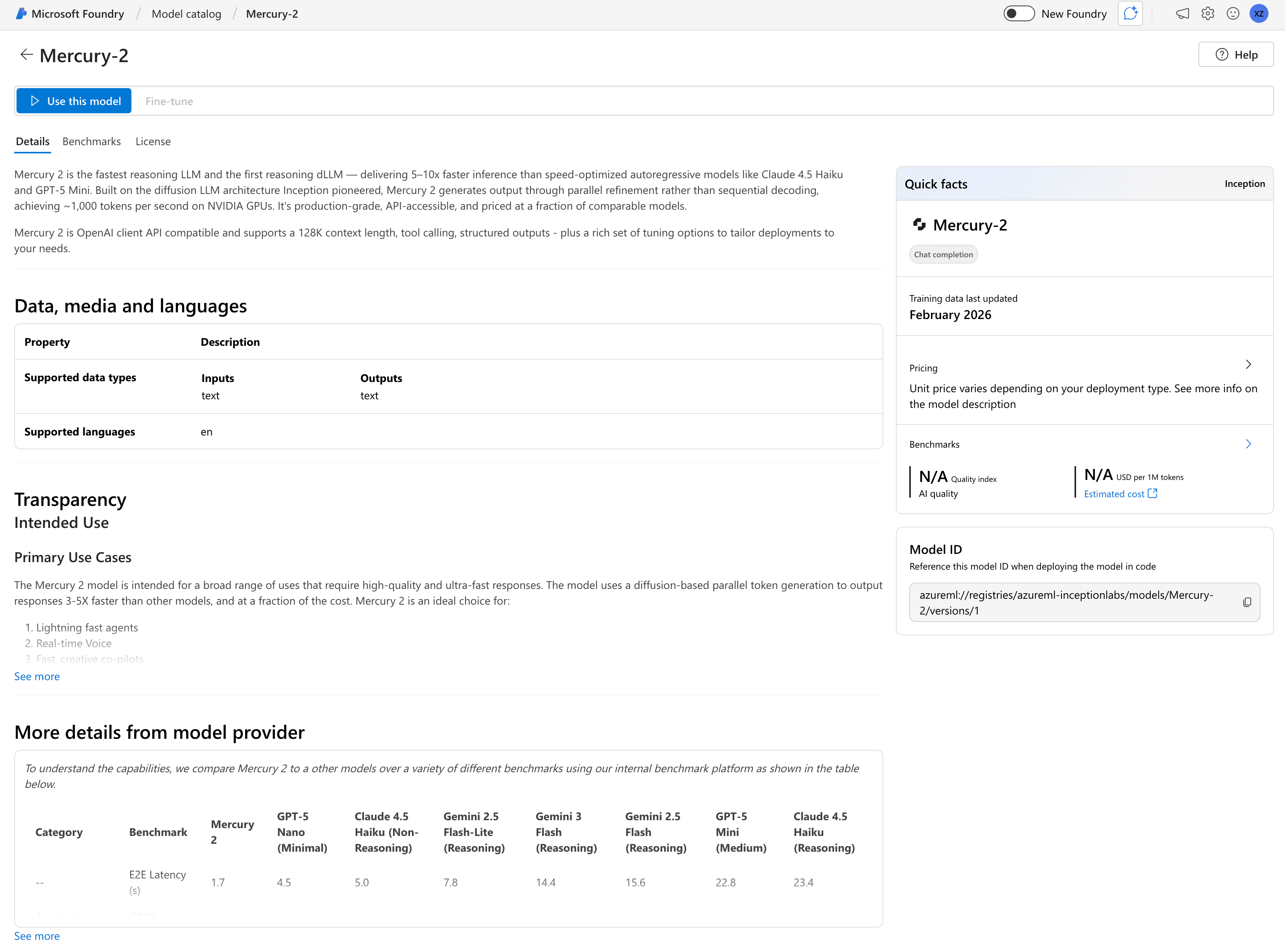
Mercury 2 is available in the US and Canada regions through Azure AI Foundry. Deployment is straightforward—provision your model endpoint and configure your infrastructure through Azure AI Foundry’s unified catalog. The Mercury 2 software license costs a flat hourly rate, with compute costs billed separately through your Azure account based on the resources you provision.
Azure AI Foundry Integration
Mercury 2 integrates seamlessly with the broader Azure ecosystem. Deploy using Azure AI Foundry's model catalog, apply Azure AI Content Safety for content filtering, monitor performance and costs in real-time, manage access with Azure RBAC and managed identities, and build multi-model applications using Azure's agent framework.
Get Started in Three Steps
Navigate to Azure AI Foundry’s Model Catalog, search for Mercury 2, and click on the model card. Alternatively, you can visit our model card here
Click on Use this model, choose a project, and follow along the UI prompts to provision your desired capacity.
While the default configuration should work for most developers, we recommend choosing ND-H100-v5 instances for optimal speeds. The deployment should take a few minutes to finish.
That’s it! You should now be able to start building with your newly provisioned API endpoint:
In Python
The Future of Real-Time AI
The launch of Mercury on Azure AI Foundry marks a turning point for production AI applications. Developers no longer have to choose between speed and quality, between real-time responsiveness and frontier-model capabilities.
Deploy Mercury 2 on Azure AI Foundry →
For detailed documentation, benchmarks, and integration guides, visit the Mercury model card in Azure AI Foundry.